
Between the Stillness and Movement of Imbolc
Honouring Rhythm, Terrain, and the Return of Perceptual Intelligence


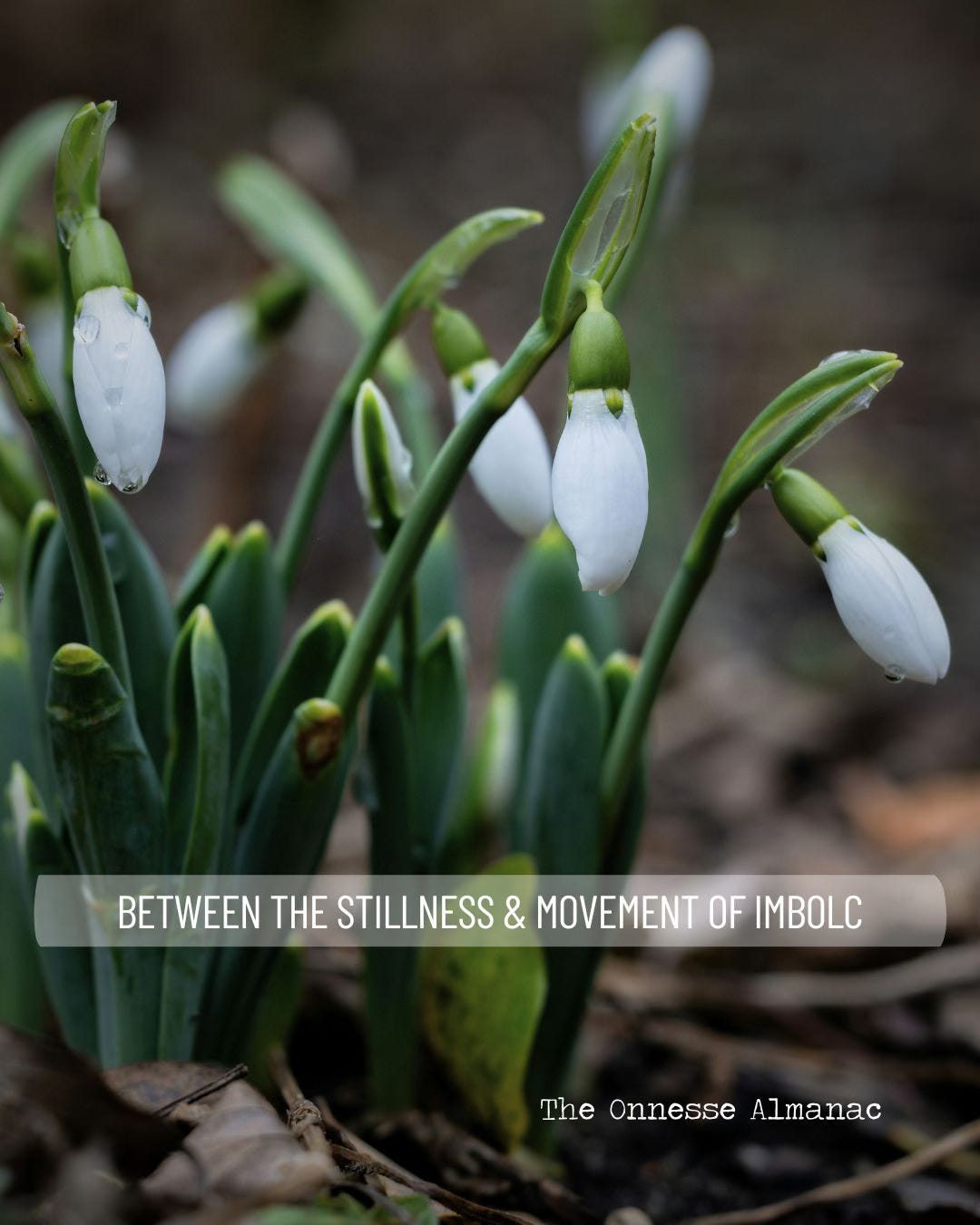
The Light Shifts Before We Do
Not dramatically. Not all at once.
Just enough to be sensed.
A little earlier in the morning.
A little more present in the afternoon.
A subtle change the body notices long before the mind makes meaning of it.
This is Imbolc.
And yet, for many, the body does not feel ready.
There is still tiredness here.
Slowness.
The residue of winter held in muscles, mood, immune systems, sleep.
This apparent mismatch — light increasing while capacity remains low — is not a problem to solve. It is the seasonal terrain.
Imbolc is not the start of spring.
It is the moment we first have to learn how to read change without rushing to respond.
A Threshold, Not a Beginning
Imbolc has always been a threshold season.
Historically, it marked a time of careful attention rather than action. A moment when life was sensed stirring beneath the surface, but still required protection. Lambing season had not yet arrived; stores were not yet replenished. What mattered most was pacing, observation, and restraint.
We live in a world of constant illumination, continuous productivity, and immediate response. Signals are treated as instructions. Urgency is mistaken for readiness. Movement is rewarded long before conditions are stable enough to support it.
So when Imbolc arrives — with its subtle increase in light — many people feel pressure rather than clarity.
This is not intuition failing.
It is orientation being skipped.
When Sensing Arrives Before Readiness
Biologically, the body begins to register changes in daylight long before it has recovered from winter.
Circadian systems respond quickly to light cues. Mood, alertness, and anticipation may begin to lift in response. But metabolic recovery, immune resilience, nervous system tone, and energy availability lag behind by weeks, sometimes months.
The result is a familiar late-winter experience:
Interest without stamina.
Desire without fuel.
Urgency without direction.
Nothing is wrong here.
Imbolc is informational.
It tells us that change is coming — not that it is time to move.
Orientation Before Action
This is why Imbolc can feel destabilising if we don’t understand its function.
The season asks us to orient before we act.
Orientation is not a pause imposed from the outside. It is a biological and psychological necessity — the groundwork that allows action to emerge in time. It is the process by which the nervous system locates itself accurately within changing conditions before committing energy.
Without orientation, action becomes reactive.
Effort increases, but timing suffers.
Burnout often follows not because people care too little, but because they respond too quickly to early signals.
Imbolc offers a different approach.
It teaches us how to stay with the stir without being carried by it.


An Imbolc Orientation
A practice for sensing without urgency
Choose a moment when the light is changing —
early morning, late afternoon, or the soft edge between.
Sit or stand where light is present if you can — near a window, doorway, or simply where the room feels most alive.
There is nothing to prepare. Arrive as you are.
Let your eyes rest where light meets surface.
You don’t need to hold your gaze.
If it moves, let it move.
Begin by noticing:
the quality of the light
its warmth or coolness
how it meets the space around you
As you notice, you may feel sensations arise — thoughts, images, impulses, emotions, information. This is natural.
If your attention follows what you sense, that’s fine.
When you notice it has moved outward, gently bring awareness back to your body.
You might place a hand somewhere that feels grounding — chest, belly, throat, back — or simply feel the contact of your feet or seat.
Let the rhythm be:
sensing
noticing
returning
Again and again.
There is nothing to stabilise, understand, or decide.
If it feels helpful, you might quietly acknowledge:
Something is stirring.
You do not need to act on this.
You are simply keeping it company.
Stay for a few breaths, or longer if the body invites it.
When you leave, do so without closing the experience.
This practice has no destination and no requirement.
It is not meant to be completed.
It belongs to moments when awareness is increasing before clarity arrives — when orientation, not action, is what supports you most.


Rhythm Without Autopilot
Orientation does not require withdrawal from life.
Often, it happens through the most ordinary acts — the ones that restore rhythm, sequence, and presence without demanding insight or analysis.
Walking is one of these.
A regular time of day.
A familiar route.
Or the same walk, noticed differently.
The nervous system settles into the predictability of timing while remaining awake to variation: the quality of light, the temperature of the air, the sound of the ground underfoot, the atmosphere of a place.
The structure stays steady within it.
The experience stays alive.
Warming the System Gently
For many bodies, orientation is supported not only by rhythm, but by warmth.
Eating and cooking can work in the same way.
Cooking that requires time, heat, and presence — stirring, simmering, waiting — reinforces sequence. It tells the body there is time, that care is ongoing, and that nothing needs to be rushed.
Certain traditional foods naturally meet this moment in the season.
This is not about optimisation.
It is about restoring trust in timing.
Containment, Light, and Fire
Clothing, too, plays a role.
Layers. Weight. Texture.
Dressing for warmth and protection rather than display.
These are quiet orienting signals that work continuously throughout the day, reminding the nervous system where the boundaries are, and that it does not need to brace.
Fire and light do this as well.
A lamp instead of overhead glare.
A candle.
The warmth of an oven or stove.
Fire gathers attention. It creates a centre. It slows the field around it.
Not Yet Is Also an Answer
None of these are routines to perfect.
They are containers that allow awareness to return.
When rhythm is in place, the system can relax enough to notice. And when noticing returns, orientation follows naturally.
Often, the answer at Imbolc is simply:
Not yet.
That is not failure.
That is seasonal intelligence.


Let the Light Arrive
Imbolc is not a season of answers.
It does not require plans, declarations, or forward motion. It is not a test of readiness or resilience.
It is a season of calibration.
A time to ask:
Where am I actually standing?
What is available now — not ideally, but honestly?
What is being sensed, and what is being asked?
When orientation is honoured, energy stops leaking through premature effort. Desire becomes quieter, but clearer. Spring arrives without being forced.
The light is returning.
There is no need to chase it.
Let it arrive.
Carrying the Season Forward
Imbolc does not resolve itself in a single moment.
Its work continues quietly, often in the background — in how you pace your mornings, how you respond to the return of light, how you resist the urge to move before your system has caught up.
Over the coming days and weeks, you might notice:
How subtle changes in light affect your energy and mood
How rhythm supports you more than motivation
How warmth, regular nourishment, and containment reduce urgency
How much becomes clearer when you allow things to remain undecided
Orientation does not announce itself.
It reveals itself gradually, through steadier attention and fewer corrections.
If you’d like to go deeper, the full Imbolc piece in the Journal explores this season’s terrain more comprehensively — holding the wider context, the seasonal intelligence, and the longer arc of orientation without force.
If warmth and nourishment are part of how you orient at this time of year, a simple, adaptable bone broth recipe in the Journal offers a practical way to support the body through late winter — grounding, warming, and quietly restorative.
You may also wish to revisit the Winter Solstice Almanac, where stillness, repair, and the biology of rest are held at the centre of the season. Imbolc does not replace that work — it carries it forward, asking how stillness begins to reorganise itself as light returns.
The Wheel does not move in clean segments.
Each season threads into the next.


A Field Note
From me to you.
Imbolc is not something to do.
It is something to listen to — gently, without interrogation.
You may find yourself returning to this threshold again and again:
on a morning walk, while cooking, while noticing the quality of light at the window, or in moments when urgency arises without instruction.
Let this season remain unfinished.
Let it be provisional.
Let it move at the pace of trust rather than demand.
Imbolc reminds us that orientation is not about finding answers,
but about staying in relationship with what is beginning to stir.
Love Michelle xx
The Onnesse Almanac lives here as a seasonal, reflective space — shaped by rhythm rather than urgency, and guided by integrity, enquiry, and conscious stewardship.
It is a place for noticing, remembering, and listening. For honouring the seasons as they move through the body and the wider world. For reflection that empowers rather than instructs, and for leadership that is conscious and compassionate.
The Night Garden also lives here — not as a phase or a moment, but as a year-round orientation toward presence, continuity, and inner steadiness.
If this way of being resonates, you’re welcome to subscribe and receive new field notes as they arrive.