
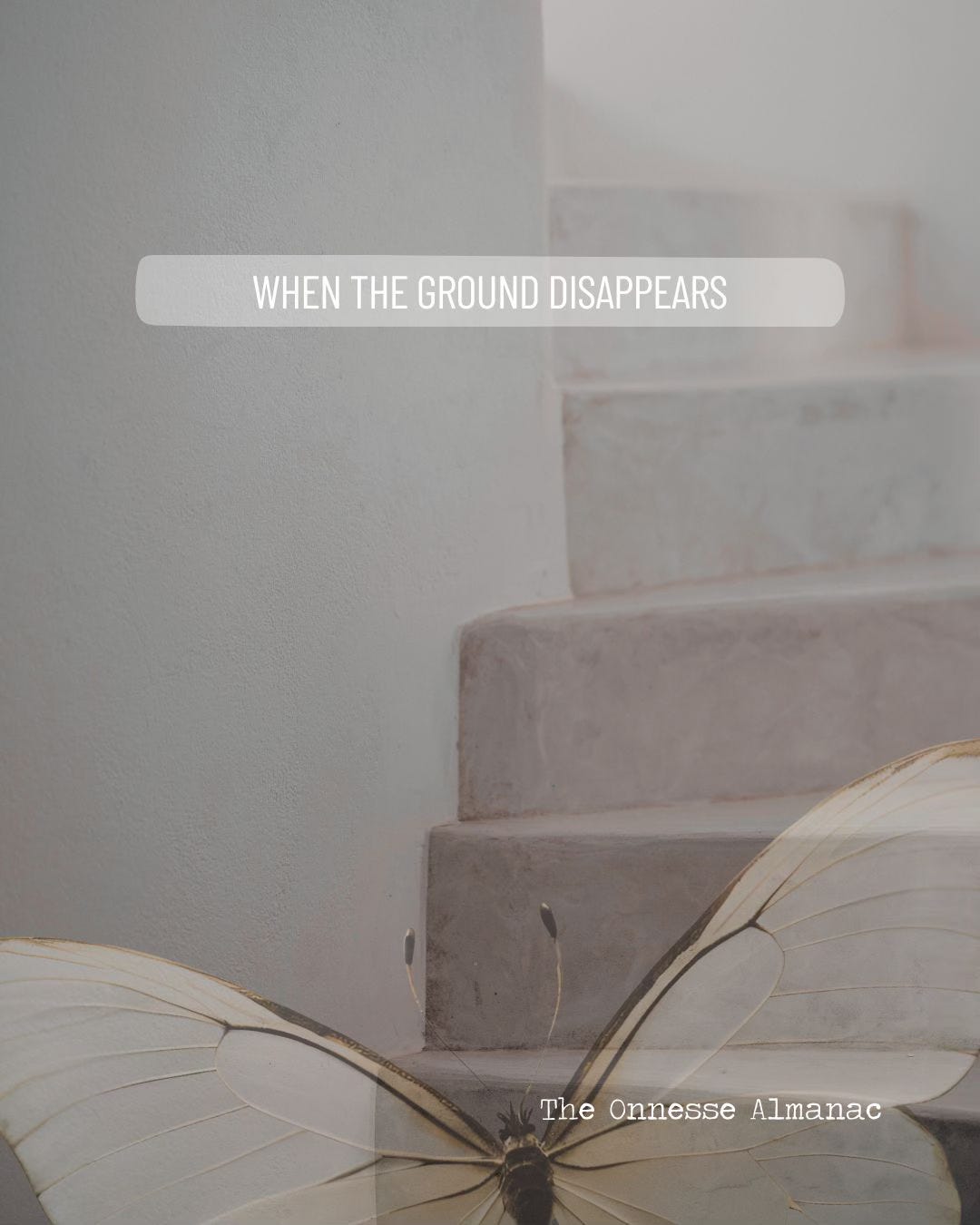
When the Ground Disappears
FIELD NOTES | On when old frames collapse and new terrain is not yet visible

Naming the loss of scaffolding
Many people are noticing something difficult to name.
Not panic.
Not fear with a clear object.
More a sense of groundlessness — as if something that quietly held life in place has gone missing.
This feeling is not imagined.
And it is not personal failure.
What is dissolving right now is not just confidence in particular systems, figures, or narratives.
What is dissolving is scaffolding — the unseen structures that once provided orientation within the wider terrain.
For a long time, many of us lived inside structures that were flawed, unjust, or deeply misaligned — and yet they provided orientation. They implied order. They suggested someone was in charge. They offered predictability, even when that predictability came at a cost.
Those structures were never truly safe.
But they were structural.
As they fall away, the nervous system does not immediately feel relief.
It feels unheld.
But unheld is not the same as unsafe.
Why truth does not automatically feel stabilising
There is a widespread assumption that once truth is revealed, the body will relax.
That assumption misunderstands how humans orient.
Orientation is not created by truth alone.
It is created by reliable frames — temporal, relational, cultural — that tell us where we are and what holds.
When long-standing frameworks collapse faster than new ones can form, the system registers:
Loss of reference
Loss of perceived protection
Loss of shared meaning
This can feel like instability, even when the direction of change is welcome.
The body is not resisting truth.
It is registering the absence of replacement structure.
This is not collapse — it is de-scaffolding
What many are calling “collapse” is more accurately described as the removal of compensatory supports.
For years, individuals — especially women — compensated internally for what was missing externally:
Regulation substituted for safety
Resilience substituted for support
Insight substituted for accountability
Endurance substituted for care
Those adaptations worked well enough to keep life functional.
Now, as the larger paradigm loses credibility, those internal compensations are being asked to do more than they can.
This is why people feel:
More aware but less steady
Clearer but not calmer
Awake yet strangely unmoored
Nothing has gone wrong.
A load-bearing illusion has been removed.
Why destabilisation precedes clarity
When scaffolding disappears, the nervous system does not celebrate the future.
It looks for ground.
And if no new ground is yet visible, the system enters a temporary state of heightened alert — not because danger is imminent, but because orientation is incomplete.
This is a normal response to structural loss.
It does not mean:
You are regressing
You are failing to regulate
You are “not coping well enough”
It means you are responding accurately to a world between forms.
When external scaffolding falls, internal authority reorganises
There is another layer to this moment.
When familiar structures dissolve — even flawed ones — something subtle begins to shift.
Attention withdraws from projection.
Perception sharpens without instruction.
Dependency loosens where it was once unquestioned.
The loss of external certainty does not only create instability.
It also exposes how much authority was projected outward.
As scaffolding falls, orientation has fewer places to attach.
Slowly — not triumphantly, not instantly — something else begins to strengthen:
Discernment
Self-trust
Direct perception
Orientation that is not borrowed
This does not feel empowering at first.
It feels like exposure.
But groundlessness is not empty space.
It is unclaimed ground.
And what forms there will not look like what preceded it.
A simple orientation for the now
If things feel unsteady, consider this frame:
Something that once held has gone.
What replaces it is not yet fully formed.
My nervous system is responding to that reality.
If the body feels heightened, place one hand lightly on your chest or belly.
Feel your feet against the ground beneath you.
Nothing needs to change.
No action is required.
No fixing.
No conclusion.
Just location.
It is allowed to feel like this.
And it will change.
A Field Note
From me to you.
This is not the moment to rush meaning into place.
It is the moment to name what has already fallen away.
Ground returns after it is lost — but not on demand, and not all at once.
What emerges next will not resemble what has fallen.
It will not be imposed structure — fast, loud, externally stabilising.
It will be relational structure.
Forms shaped through reciprocity rather than hierarchy.
Orientation that arises through interdependence rather than compliance.
Living systems do not rebuild through force.
They reorganise through exchange.
And reorganisation takes time.
For now, orientation is enough.
And you are not alone.
With love from the field,
Michelle xx
The Onnesse Almanac lives here as a seasonal, reflective space — shaped by rhythm rather than urgency, and guided by integrity, enquiry, and conscious stewardship.
It is a place for noticing rather than fixing.
For remembering rather than striving.
For reflection that empowers rather than instructs.
The Night Garden also lives here — not as a phase to move through, but as an ongoing orientation toward presence, coherence, and remaining with Self.
If this way of meeting life resonates, you’re welcome to subscribe and receive new field notes as they arrive — without expectation, obligation, or agenda.